


It’s been no secret that I have not been a big fan of the return of J.T. Miller to the Rangers. When he was acquired I thought that Chris Drury overestimated the impact he’d make, and failed to address the real needs of the team – to get younger and faster. I also didn’t like them making him captain last season. He just seemed to be the kind of guy who was too emotional, and still carried some of that immaturity that plagued him in his first stint here.
He was not the kind of captain that lead by example like Ryan Callahan, nor was he the motivational speaker of the likes of Mark Messier. When the going gets tough, Miller doesn’t have any answers.
LAST SEASON DID NOTHING TO CHANGE MY MIND
Miller ended the year tied for fourth on the team with Vincent Trocheck for with 53 points. It was his worst season in terms of points per game since 2018-19 season with the Tampa Bay Lightning just before they traded him to Vancouver following a 47 point effort in 75 games.
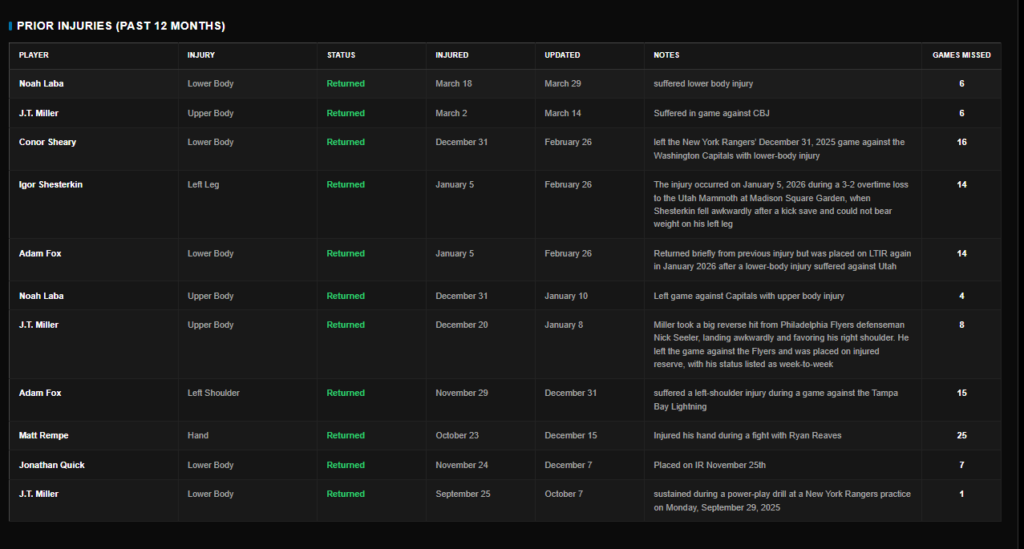
Granted he had injuries. At least two of them, maybe three. He did still manage to play fourth line on Team USA at the Olympics though, and it half felt that his absence from December 20th through to January 8th was at least in part in order to make sure he was healthy enough to play for the national team – though there was certainly no overt admission.
Did making him captain of the Rangers change his ways? Well not exactly, here’s former Ranger Sean Avery calling out the captain’s defensive play following a 3-2 loss to the Vegas Golden Knights last November, where Miller makes little to no effort to help the team recover the puck in his own end.
This is a bit of a pattern for the Rangers leader and it was widely known at the time of the trade by Drury. They gave up Filip Chytil, Vincent Mancini and a 2025 top-13 protected first round pick. The same pick the Canucks used to acquire Marcus Pettersson from the Pittsburgh Penguins. Fortunately Drury elected to give the pick up last year instead of this year, allowing the Rangers to pick Albert Smits with the fifth overall this past NHL draft.
The Flyers ended up with what would be the 12th overall pick, and selected Jack Nesbitt who had a bit of a plateau season for the Windsor Spitfires, so aside from having to spend another 1st round pick this year to acquire Pettersson, the Rangers payment for Miller at least hasn’t been too bad.
THAT’S INTERESTING
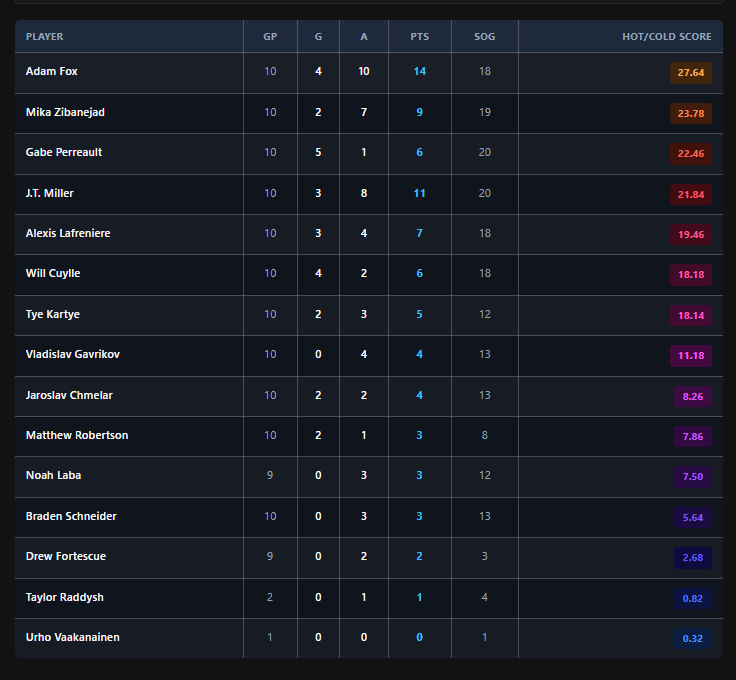
You can see why I haven’t liked the guy, but then it got a little interesting. As I’ve been working on the site to create a bunch of new analyses for the Rangers going forward, a couple of things started to stick out. First off he ranked 4th on the team in the hot and cold report, which showed that he was among the better Blueshirts to end the season.

Then he showed up as an outlier in the Goal Value report, which attempts to give more value to certain types of goals over the course of the season. Only Matthew Robertson had a higher variance in terms of his actual goals (6) versus the value of the goals in contributing to wins (7.925) – a 32% variance. Miller had 17 goals last year for a calculated value of 22.193, or a 30.55% variance.
Amongst top six forwards for the Rangers last year, only Mika Zibanejad had a positive number, and his 34.8 value to 34 goals barely broke above even.
But hey, this is all very experimental, and hardly proven at this stage.
A CLOSER LOOK
So rather than just rely on my own numbers, I started to look at some of the other indicators out there. NaturalStatTrick.com is a site I often refer to for some of the more accessible advanced stats, and they put him relatively high for a bunch of solid indicators.
His Individual Point Percentage – the amount of times he registered a point when he was on the ice for a Rangers Goal – was a solid 67.09. It meant that he contributed in some way to two thirds of the goals he was out there on the ice for. It ranked him sixth on the team in forwards with over 50 games, though higher than both Vincent Trocheck and Alexis Lafreniere.
When you look as his individual effect on Expected Goals, he jumped to third, narrowly trailing Zibanejad and Lafreniere. When it came to Individual High Danger Chances For he was top of the class with 115 followed by Lafreniere at 111 and Will Cuylle with 106.
His numbers did drop slightly at Even Strength, which reinforces the perspective that he does get a little bit more out of the power play than your average player.
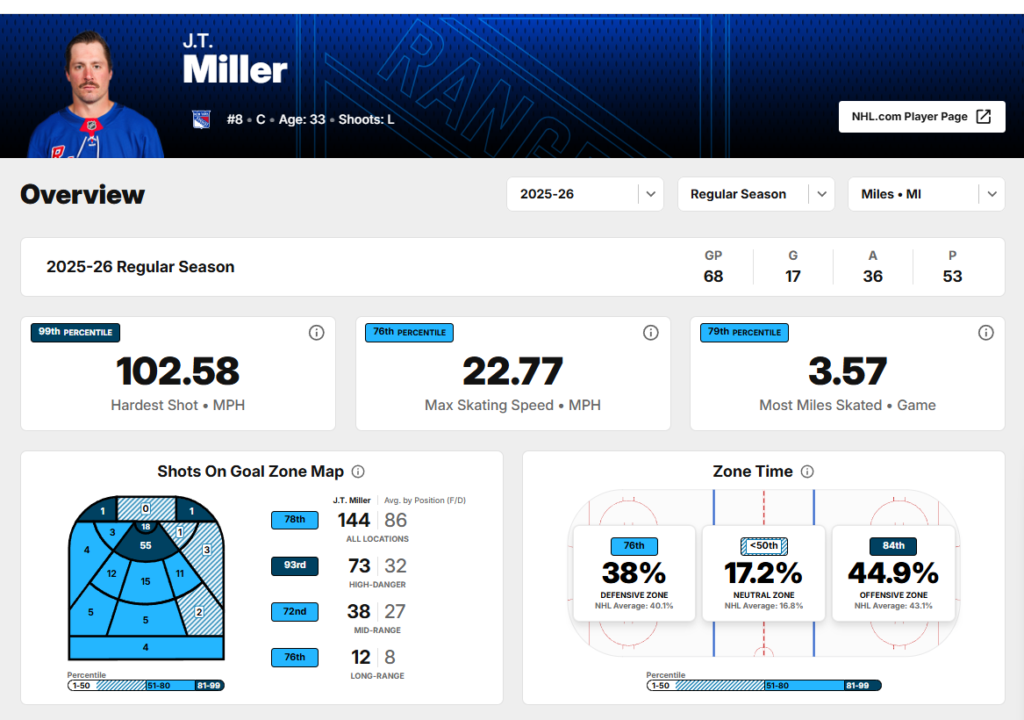
When you take a look at the NHL’s Edge Stats, you get a clearer picture of why some of these numbers stand out. Take a look at where most of his shots come from and where he ranks in that spot. Hint: It’s in front of the goalie.
Here’s Zibanejad’s by comparison:
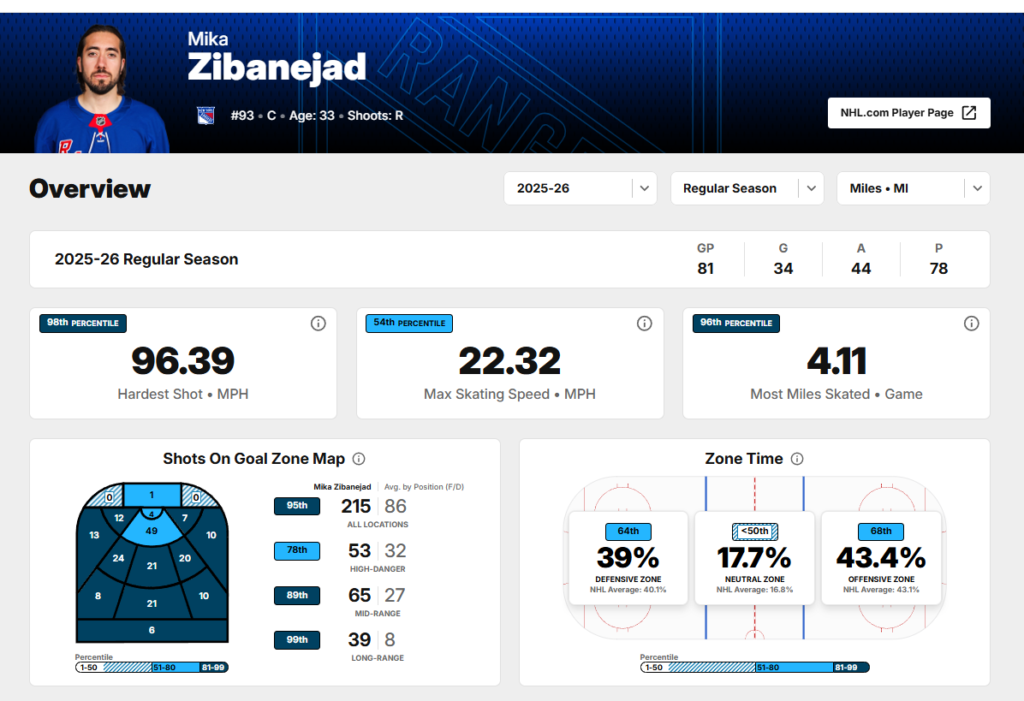
They’re almost opposites in terms of where they shoot from
DRAWING CONCLUSIONS
Miller’s defensive lapses, effort and captaincy issues are all fair targets. He’s not exactly one-dimensional, but you’re not going to want to put him out there with guys who don’t have some defensive acumen to counter the gaps in his game. Hopefully the changes to the defense depth will help offset at least some of the challenges, though as we saw in the Avery critique, that goal could have been the difference between 0 points, and 1 or even 2.
Stripping him of the captaincy would be a good move too. There doesn’t appear to be any evidence that he’s the leader the Rangers need, though as was the case prior, it’s not clear who is successor would be yet.
It hinges on his health and offensive production. Miller clearly has the ability to contribute offensively at the NHL level. He’s not a huge play driver at 5v5, but even at 33 years old, he still has the ability to score in those “greasy” spots. It’s a dimension that the Rangers lack since driving Chris Kreider out of town.
Can he avoid the injury bug? His style is still favors the physical side, and the injury that sidelined him on December 20th was the direct result of a reverse hit, so there’s definitely an increased risk there. Maybe he gets lucky. Probably he doesn’t
At least he’s only here another four years.


 CAR
CAR PHI
PHI PIT
PIT WSH
WSH CBJ
CBJ NYI
NYI