



It’s really hard to predict how many goals a player, or even the Rangers as a whole will score in a season. That’s true, largely because the sample sizes are so small that they’re often statistically insignificant. We do have a lot of Rangers-centric data here at OTG, and perhaps at some point I’ll try and use that historical data to create a different view, but for now I’m using simple career stats for each player to try and do the impossible: predict who will play, and who will score goals.
Injuries are a challenge to predict for sure, but I wanted to take into account that some players have had more injuries than others in recent years. I’m talking about you Adam Fox, J.T. Miller and Sean Durzi. The model I’ve built tries to factor that in as part of the consideration too.
So let me walk you through how I built this model.
BLOOD, SWEAT AND TIERS
The first thing I need to do was figure out who was the most likely to play. To do this I broke each player down into one of seven tiers.
TIER 1 – Healthy NHLer
TIER 2 – NHLer but missing 5+ games through injury or other
TIER 3 – Younger-player establishing himself
TIER 4 – Veteran line fillers
TIER 5 – Up and Comers
TIER 6 – The fringe
TIER 7 – Has NHL experience
The reason I did this, was to prioritize who would play, and then what their prior games might mean in terms of projecting out where they might land this season.
It doesn’t of course predict a serious injury, and nor does it necessarily do a great job of projecting that young guy who breaks into the line-up after minimal exposure – think Adam Sykora, and complete ignores a guy like Noah Laba who could break into the line-up straight out of camp. To be honest it is really difficult to predict those guys and what sort of impact they might have.
It does however cap the number of forward games as 1008 and 504 for defensemen. It’s just simple math there, 84 game season, 12 forwards, 6 defensemen. Sure Sullivan could go 11/7 some games, but they’re anomalies rather than the rule.
For players who missed games, but are in TIER 2, I do use a weighted average over the past four seasons, gradually reducing the effect as you go back in time. As a player stays healthy, or stays in the line-up from season to season, they project more games.
GAME ON!
Now that I have the projected games, I can turn my focus to how that might translate into projections for the coming season. I do this by calculating out the average shots per game the player takes, and what that translates into in terms of shooting percentage.
Filtering out the outliers on the low end are important though, as many players get a cameo or two before they start to hit their stride, and so I filter out seasons where 0 goals were scored and under 20 games were played. I do that for the prediction, as well as the “Worse” column.
You can still see those represented in the “Career Lows” section, but I don’t use them to calculate out the projections.
BEST KEEP THINGS IN PERSPECTIVE
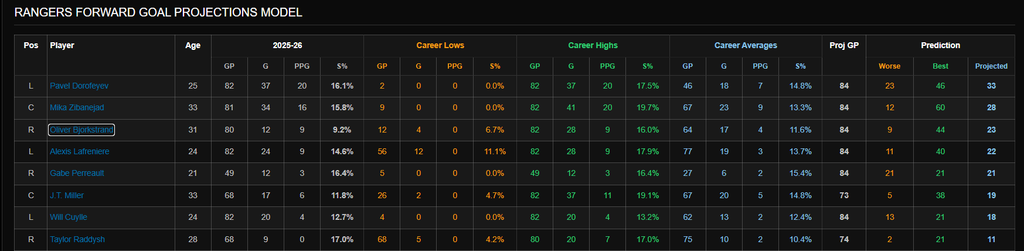
Overall you can see the Rangers are predicted to get 256 goals by the model, 21 goals more than what this collection of players scored last season. It definitely feels reasonable, though some of those goal totals look kind of hopeful – this time I’m looking at you Oliver Bjorkstrom.
Where it really gets fun though is in the “Best” column. Looking at a guy like Mika Zibanejad, he has a top-end projection of 60 goals – that’d easily break Jaromir Jagr’s 21 year-old franchise record of 54. Chances of him doing that are VERY low of course, approaching zero, but back in 2019-20 he shot at almost 20%, and averaged around 3.6 shots a game. It was of course the COVID shortened season and he did get a minor injury along the way, but he was on a 60 goal pace.
You can see those numbers show up in other areas as well, like Taylor Raddysh and his 21 goals – he did get 20 once, and Bjorkstrom’s 44 against a career high of 28. At any rate, you can see how shooting percentage and shot totals can make some of these numbers skew at the edges.
AH WHAT ABOUT THESE GUYS?
You might also wonder why the model only projects 9 games for Scott Morrow, gives 16 to Vincent Iorio and 9 also to Drew Fortescue. It’s a fair critique, and one I’ll continue to look to find additional ways I can tune this, but you’ll notice the net results are negligible if you were to switch those guys around.

BOTTOM LINE
Aside from the futility of this whole exercise, it is the off-season and we’re still ten days away or so from the rookies reporting to camp. What else are we going to talk about? There are a couple of things that I think are interesting to look at:
- REPLACEMENT VALUE: There’s enough here to probably replace the lost offense from Artemi Panarin and Vincent Trocheck, and even a slight improvement – 13 goals more
- BETTER BUT NOT GREAT: If goals scored was the only predictor, then the Rangers would move up only a little. They were 23rd in GF last season, and would be around 16th if they had scored this many last year.
- STOPPING THEM IS GOOD TOO: Stopping another 10 goals, to improve from 250 to 240 could make enough of difference to get them into the playoff mix
- BOUNCE BACKS: The model – perhaps simplistically – expects Miller and Bjorkstrand to have bounce back years, which each carries some risk. It’s possible on both sides, if Miller can be healthier, while the Danish winger has typically been a 20 goal guy.
- YOUNG GUNS: Pavel Dorofeyev is projected to lead the team, Gabe Perreault looks to break 20 goals, and Lafreniere maybe drops back again slightly. Will Cuylle looks to be set for around 20 as well, so that’s your young offensive core.
- BLUELINERS TOO: Fox still remains the key on the blueline, and the model expects a regression for Vladislav Gavrikov after his career breakout season. Sean Durzi will chip in some, and Braden Schneider will bounce back a bit – assuming he’s still here
It could feel a little predictable, but at least there’s some logic to it. Perreault, Dorofeyev and Lafreniere probably have the biggest potential upsides, though to varying degrees. The veterans have plenty of question marks around them, though Mika Zibanejad still will be expected to be close to the 30 goal mark.
It’s hard to see though this team getting much higher than 256 with this line-up, and a lot of things will have to break their way for that to happen.
 NYR
NYR

 CAR
CAR PIT
PIT CBJ
CBJ NYI
NYI NJD
NJD PHI
PHI